logo

Ürün ayrıntıları

Created with Pixso. Evde Created with Pixso. Ürünler Created with Pixso.
Tel ip titreşim yalıtıcısı
Created with Pixso.

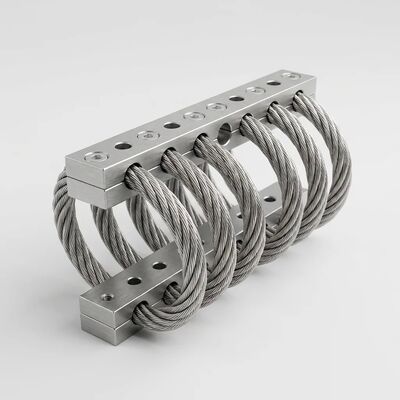
JGX-1278D-292B 3D Multi-Directional Wire Rope Isolator 292N Load 89mm Height for Precision Equipment Shock Damping

JGX-1278D-292B 3D Multi-Directional Wire Rope Isolator 292N Load 89mm Height for Precision Equipment Shock Damping

Marka Adı: Hoan
Model Numarası: JGX-1278D-292B
Adedi: 10 adet
Ödeme Koşulları: L/C,D/A,D/P,T/T,Western Union
Detay Bilgisi
Menşe yeri:
Şaanksi, Çin
Sertifika:
ISO 9001:2015
Modeli:
JGX-1278D-292B
Kablo çapı:
12,7 mm
Döngü Sayısı:
8
Maksimum Statik Yük (Dikey):
292n
Maksimum Deformasyon (Dikey):
43,2 mm
Titreşim Sertliği (Dikey):
613 KN/m
Şok Sertliği (Dikey):
278 KN/m
Toplam Yükseklik (H):
89 mm ±3,30 mm
Genel Genişlik (W):
105mm
Birim ağırlığı:
2.00 kg
Montaj deliği:
φ9,0mm Delikten
Konu boyutu:
M8 × 1,25
Havşa Açısı:
90°
Montaj Seçenekleri:
A, B, C, D, E, S
Kablo malzemesi:
paslanmaz çelik 304
Tespit Çubuklarının Malzemesi:
Paslanmaz Çelik 304 veya Alüminyum Alaşımlı
Yüzey İşlem (Alüminyum):
Beyaz Eloksal / Sert Eloksal
Sıcaklık Aralığı:
-180°C ila +300°C
Başvuru:
Endüstriyel Otomasyon, Veri Merkezleri, HVAC Sistemleri, Hassas Aletler
Vurgulamak:

3D Multi-Directional Wire Rope Isolator

,

Extreme Environment Shock Absorber

,

Stainless Steel Cable Isolator 292N

Ürün Tanımı

JGX-1278D-292B Multi-Directional Wire Rope Vibration Isolator — 3D Shock & Vibration Control for Critical Industrial Equipment

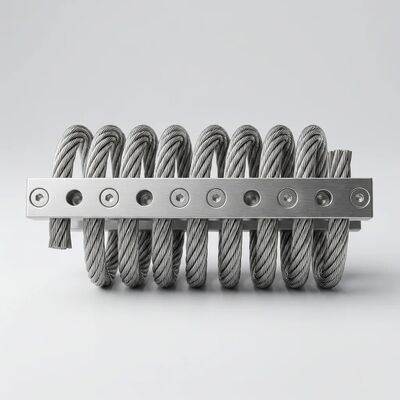
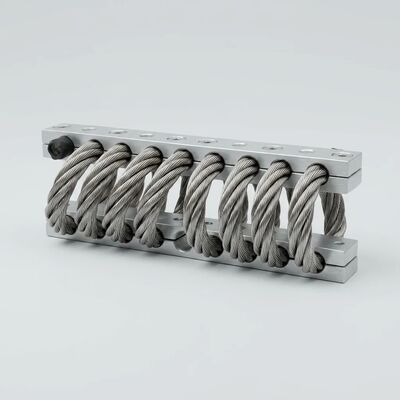
The JGX-1278D-292B is an all-metal wire rope vibration isolator purpose-built for three-dimensional (3D) multi-directional shock and vibration attenuation in industrial environments where conventional single-axis mounts reach their performance limits. Rated at 292N maximum vertical static load, with an installed height of 89mm and a width of 105mm, this isolator utilizes an 8-loop, 12.7mm-diameter stranded 304 stainless steel cable to deliver omni-directional energy dissipation through Coulomb (inter-strand friction) damping. The all-metal architecture ensures indefinite service life without creep, ageing, or maintenance—making it a definitive choice for precision instrumentation, data center infrastructure, telecommunication installations, and automated production systems.

Why 3D Multi-Directional Isolation Matters

Real-world mechanical vibration rarely arrives from a single direction. A pump on the floor below transmits vertical rumble through the building structure. A nearby conveyor generates lateral sway. Thermal expansion of pipework imposes angular displacement. A passing forklift delivers a sharp, multi-vector impact. Each of these disturbance sources acts along a different spatial axis—and a single-axis isolator can only address one of them effectively.

The JGX-1278D-292B addresses this fundamental limitation through its figure-eight helical cable geometry. The stranded construction creates thousands of microscopic contact points between individual stainless steel wires. When vibration energy enters the isolator from any direction, these contact interfaces undergo relative micro-displacement, converting kinetic energy into negligible heat through solid friction—a phenomenon known as Coulomb or hysteretic damping. Unlike viscous damping (which depends on velocity and fluid properties), Coulomb damping is displacement-dependent and operates effectively across all six degrees of freedom: three translational (X, Y, Z) and three rotational (pitch, roll, yaw).

JGX-1278D-292B — Complete Multi-Axis Load Ratings

The following table presents fully characterized load-deflection and stiffness data for all three primary loading orientations. These values are derived from Type II testing in accordance with MIL-STD-810 equivalent methodology, adapted for commercial-industrial applications:

Table 1: Load-Deflection and Stiffness Data — JGX-1278D-292B
Loading Direction Max Static Load Max Deformation Vibration Stiffness Shock Stiffness
Vertical — Compression 292 N 43.2 mm 613 KN/m 278 KN/m
45° Angled — Combined Compression & Shear 208.8 N 61.0 mm 349 KN/m 138 KN/m
Lateral — Shear / Roll 158.9 N 45.2 mm 173 KN/m 173 KN/m
Key data interpretation: The vibration-to-shock stiffness ratio in the vertical direction is 613 ÷ 278 = 2.20*. This non-linear characteristic is the defining advantage of wire rope isolators: the cable assembly is approximately 2.2 times stiffer during routine low-amplitude vibration than during high-energy shock events. In practical terms, the isolator provides firm, stable support for normal equipment operation while simultaneously offering compliant, energy-absorbing behavior when an impact or overload occurs. No external control system, valve, or adjustment is needed to achieve this dual-mode response.

Material Science: All-Metal Construction vs. Polymer Degradation

The JGX-1278D-292B contains zero elastomers, zero adhesives, zero hydraulic fluids, and zero bonded joints. Every component—from the 7*19 stranded 304 stainless steel cable to the precision-machined 6061-T6 aluminum or 304 stainless steel retaining bars—is metallic. This materials strategy is not simply about durability; it eliminates every known degradation pathway that limits elastomeric isolator service life:

Table 2: Degradation Mechanism Comparison
Failure Mechanism Elastomeric (Rubber) Mounts JGX-1278D-292B (All-Metal)
Ozone attack Surface cracking begins within 18-36 months of outdoor exposure; cracking propagates to functional failure within 5 years No effect — inorganic stainless steel is chemically inert to ozone
Ultraviolet (UV) radiation Polymer chain scission causes progressive surface hardening; 25-40% stiffness increase after 3 years of direct sunlight No effect — metallic bonding is unaffected by UV photon energy
Thermal cycling (-40°C to +80°C) Differential thermal expansion at rubber-metal bond line causes interfacial stress; eventual bond separation No bonded interface to separate; 304 SS CTE: 17.2 μm/m·°C; 6061-T6 CTE: 23.6 μm/m·°C — both linear and reversible
Creep / compression set 15-25% permanent height loss after 2 years under static load at 23°C; accelerates at elevated temperature Zero measurable creep — stainless steel operates below its yield point at rated loads
Oil & hydrocarbon contact Volume swelling of 20-60% (depending on elastomer type); loss of load-bearing capacity and dimensional stability No absorption — 304 SS is impervious to all hydrocarbons, solvents, and industrial fluids
Fatigue under cyclic loading Hysteretic heating causes internal temperature rise; progressive softening; eventual catastrophic tear Friction damping is self-limiting — energy dissipation generates negligible bulk temperature increase; no fatigue limit concern at design loads
Salt spray corrosion Galvanic corrosion at steel-rubber bond edge; rust jacking delaminates the bonded interface 304 SS passive chromium oxide layer provides self-healing corrosion resistance; no dissimilar-metal bond to create galvanic cell

Physical Dimensions & Mechanical Interface

Table 3: Dimensional and Interface Specifications
Parameter Specification Notes
Model JGX-1278D-292B JGX = Cable Isolator; 1278 = 12.7mm cable, 8 loops; D = standard bar; 292 = rated load (N); B = bar type code
Overall Height (H) 89mm ±3.30mm Measured from bottom of lower bar to top of upper bar, unloaded
Overall Width (W) 105mm Bar length (end-to-end)
Unit Weight 2.00 kg With aluminum retaining bars; add ~35% for stainless steel bar option
Cable Specification 12.7mm diameter, 7*19 strand construction 7 strands per cable; 19 wires per strand; type 304 stainless steel
Number of Loops 8 Figure-eight helical winding between upper and lower retaining bars
Mounting Hole φ9.0mm (+0.13 / -0.38) through hole Clearance fit for M8 bolt; countersunk to 90° included angle
Thread M8 * 1.25 metric coarse Tapped in retaining bar; through-hole bar option also available (Option C, D configurations)
Mounting Configurations A, B, C, D, E, S 6 standard configurations: combinations of threaded/through-hole, top/bottom bar orientations

Application Domains — Industry-Specific Isolation Solutions

Table 4: Sector-Specific Application Mapping
Industry Equipment Protected Primary Isolation Requirement JGX-1278D-292B Advantage
Data Centers Server racks, storage arrays, UPS modules, CRAC units Seismic event protection + continuous fan-motor vibration isolation All-metal = zero outgassing in airflow paths; fire-safe; 3D isolation for multi-story seismic drift
Telecommunications 4G/5G baseband units, microwave backhaul radios, fiber distribution frames Outdoor all-weather durability + low-frequency structural vibration from tower sway No protective enclosure needed; 20+ year field lifespan without on-site maintenance visits
Semiconductor Fabrication Lithography steppers, wafer probers, metrology tools, vibration-isolated optical tables Sub-micron vibration control in Class 1-100 cleanrooms No particle shedding; sterilizable; maintains damping in vacuum environments (no outgassing)
Industrial Automation CNC machine controllers, robotic pedestals, laser cutter frames, automated inspection cells Multi-axis stability to preserve micron-level positioning repeatability Simultaneous compression + shear + roll isolation; no drift over time
Oil & Gas — Processing Gas turbine control enclosures, compressor station SCADA cabinets, custody transfer metering panels Continuous machinery vibration + occasional pressure surge transients Hydrocarbon-immune; hazardous-area compatible (all-metal = no static charge accumulation)
Power Generation Generator set control cubicles, excitation panels, turbine supervisory instrumentation High-temperature proximity to turbine casing + continuous rotating machinery vibration Stable to +300°C; oil/fuel spray resistant; non-combustible
Marine — Commercial Vessels Bridge navigation consoles, dynamic positioning systems, satellite communication terminals Combined engine vibration + sea-state-induced vessel motion + salt atmosphere Salt-fog immune 304 SS; multi-axis handles simultaneous pitch+roll+vibration; compact for bridge installations
Railway Infrastructure Trackside signalling equipment, axle counter cabinets, platform passenger information systems, tunnel communication nodes Train-passing induced ground vibration + all-weather outdoor exposure Zero-maintenance remote deployment; low-frequency isolation effective below 20 Hz
Medical & Life Sciences MRI cold-head chillers, CT gantry support systems, laboratory centrifuge benches, cleanroom robotic workcells Vibration isolation in sterile/controlled environments with stringent contamination control Autoclavable, EtO and gamma sterilizable; no outgassing; no elastomer particle shedding

Retaining Bar Configuration Options

Table 5: Bar Material and Surface Finish Selection Guide
Option Material Surface Treatment Recommended Environment
A Aluminum Alloy 6061-T6 White Anodizing (10-15 μm) Indoor industrial; data centers; climate-controlled enclosures; appearance-sensitive installations
B Aluminum Alloy 6061-T6 Hard Anodizing (25-50 μm, 350-500 HV) Outdoor; abrasive/dusty environments; high-vibration locations where fretting wear is a concern
C Stainless Steel 304 None (passive oxide layer) Offshore; coastal (<5 km); chemical plants; food & pharma; any installation prioritizing corrosion resistance over weight

JGX-1278 Series — Complete Model Range for Load Selection

Table 6: Full JGX-1278 Product Family (All Models Share 12.7mm Cable * 8 Loops * 7*19 Strand)
Model Vertical Load (N) H (mm) W (mm) Weight (kg) Best For
JGX-1278D-370B 370 76 92 1.81 Heaviest compact equipment
JGX-1278D-310B 310 83 102 1.91 Heavy industrial machinery
★ JGX-1278D-292B 292 89 105 2.00 Precision instruments, data centers
JGX-1278D-235B 235 95 121 2.22 Mid-weight pumps & compressors
JGX-1278D-199B 199 108 133 2.40 General industrial equipment
JGX-1278D-176B 176 124 144 2.70 Lighter machinery, fan assemblies
JGX-1278D-154B 154 137 156 2.90 Electronic enclosures, small panels
JGX-1278D-122B 122 155 180 3.09 Sensitive lightweight instrumentation
Selection rule of thumb: Size your isolator so that the supported equipment's static weight per mounting point falls between 40% and 70% of the rated maximum load. Operating below 40% results in insufficient cable strand engagement (under-damping, reduced energy dissipation). Operating above 70% pushes the isolator into the hardening region of its load-deflection curve, reducing isolation efficiency. For the JGX-1278D-292B, this corresponds to a per-isolator target load of 117-204 N (approximately 12-21 kg supported mass). Contact our application engineering team for multi-point mounting calculations including asymmetric load distribution analysis.

Core Performance Characteristics

  • Zero creep & no ageing: 304 stainless steel cable operates in its elastic region at rated load. No permanent deformation, no compression set, no progressive stiffening or softening over time.
  • Non-linear stiffness curve: Soft initial response for fine vibration isolation; progressive stiffening as deformation increases—providing inherent overload protection without mechanical hard-stops.
  • High hysteretic damping: Coulomb friction between wire strands delivers damping ratios of 10-25% of critical. No external dashpots, tuned mass dampers, or active control systems required.
  • Broad temperature range: Consistent mechanical properties from -180°C (cryogenic) to +300°C (elevated). No low-temperature embrittlement; no high-temperature softening or creep.
  • Chemical resistance: Type 304 SS is inert to hydrocarbons, chlorinated solvents, hydraulic fluids, lubricating oils, dilute acids and alkalis, seawater, ozone, and UV radiation.
  • Progressive wear indication: Unlike rubber mounts that can tear catastrophically, wire rope isolators exhibit visible strand wear (individual wire fracture) long before any functional failure—enabling condition-based, rather than calendar-based, replacement decisions.

Installation Guidelines

  1. Mounting surface preparation: Ensure flatness within 0.5mm across the bar footprint. Use stainless steel shim plates as needed—never use plastic shims which may creep under load.
  2. Fastener specification: M8 * 1.25 bolts, minimum Grade 8.8. Include flat washer under bolt head and spring lock washer under nut. For stainless steel bar installations in corrosive environments, specify A4-80 (type 316) fasteners to match the corrosion resistance of the bar material.
  3. Tightening torque: 18-22 N·m for aluminum bar configurations; 25-30 N·m for stainless steel bar configurations. Always use a calibrated torque wrench—over-torque may deform the bar and alter cable pre-tension geometry.
  4. Alignment verification: Confirm parallelism between upper and lower mounting planes within ±2° after final torque. Misalignment beyond this tolerance causes uneven strand loading and reduces damping performance.
  5. Clearance envelope: Ensure minimum 15mm unobstructed clearance in all directions around the cable assembly to accommodate maximum deformation without contact against adjacent structures.
  6. Quantity determination: Total equipment weight (N) ÷ target per-isolator load (N) = minimum number of isolators. Round up to the nearest even number for symmetrical weight distribution. Example: a 600 N equipment package ÷ 150 N per isolator = 4 isolators minimum. Install in pairs at symmetrically opposite corners.

Frequently Asked Questions

Q: How does the JGX-1278D-292B compare to rubber mounts for compressor vibration isolation?
Unlike rubber mounts that progressively stiffen under the heat cycling typical of compressor applications, the all-metal JGX-1278D-292B maintains consistent stiffness throughout its entire service life. The non-linear stiffness characteristic also handles compressor start-up torque shock—which can displace or tear rubber mounts—without degradation. Most critically for remote compressor stations, there is no scheduled maintenance interval: install once and the isolator will typically outlast the compressor it protects.
Q: What is the expected service life of this wire rope isolator?
In normal industrial environments (indoor, moderate climate, rated load within design range), the JGX-1278D-292B has a projected service life exceeding 25 years. The stainless steel cable operates below its fatigue limit at rated static loads, and the friction-damping mechanism does not generate meaningful internal heat. The primary life-limiting factor—if any—is cumulative wire strand wear from extremely high-cycle, high-amplitude vibration, which becomes visually apparent long before functional performance is compromised.
Q: Can this isolator be used in outdoor applications without weather protection?
Yes. Unlike elastomeric mounts that require protective covers or shelters to prevent UV and ozone degradation, the all-metal JGX-1278D-292B requires no weatherproofing. For coastal or marine outdoor installations, we recommend the stainless steel bar option (Config C) to eliminate any galvanic corrosion potential between dissimilar metals in salt-spray environments.
Q: How do I determine the correct number of isolators for my equipment?
Divide your equipment's total weight (in Newtons) by the target per-isolator load (we recommend 40-70% of the rated maximum: 117-204 N for the JGX-1278D-292B). For equipment with an uneven center of gravity, provide our engineers with a weight distribution diagram and we will calculate the required quantity and placement for each support point at no charge.
Q: Is any lubrication or maintenance required?
No. The JGX-1278D-292B is a completely passive, lubrication-free device. The damping mechanism relies on dry solid friction between stainless steel wire strands—there are no sliding bearing surfaces, no sealed lubricant cavities, and no components that require periodic servicing. An annual visual inspection during routine equipment walk-downs is sufficient to confirm continued serviceability.

Quality Assurance & Manufacturing

Every JGX-1278D-292B is produced under an ISO 9001:2015 certified quality management system. Manufacturing controls include:

  • Raw material traceability: Full mill test certification for 304 SS wire to ASTM A313/A313M and 6061-T6 aluminum bar to ASTM B221/B221M
  • Cable winding: CNC-controlled helical winding with real-time tension monitoring (±5% of nominal)
  • Crimping process: Hydraulic crimp with force-displacement monitoring; SPC data logged and trended per production lot
  • Dimensional verification: CMM inspection of retaining bar critical dimensions—hole position, countersink depth and angle, thread form and class
  • Performance validation: Lot-acceptance static load-deflection testing per AQL 1.0, Normal Inspection Level II
  • Surface finish: Anodizing thickness measured per ISO 2360 (eddy current method) for aluminum bar configurations

About Xi'an Hoan Microwave Co., Ltd.

Founded in 2005 and headquartered in Shaanxi, China, Xi'an Hoan is a specialized manufacturer of vibration isolation, shock absorption, and energy dissipation solutions for commercial and industrial markets worldwide. Our workforce of 500+ personnel includes over 100 engineering and quality assurance professionals. Our 35+ country export footprint spans industrial machinery OEMs, engineering and procurement contractors, reliability and maintenance teams, and equipment retrofit specialists.

Our product portfolio encompasses wire rope isolators (JGX, GR, GRY series), rubber-metal composite mounts, coil spring isolators, friction dampers, and application-specific customized isolation assemblies. We maintain an active R&D program in advanced damping materials, non-linear structural dynamics, and finite-element-based isolator performance optimization.

Request a quotation or schedule a technical consultation: Provide your equipment specifications—supported weight, mounting footprint dimensions, operating environment conditions, and vibration isolation performance objectives—and our applications engineering team will respond with a tailored JGX-1278 series recommendation within one business day. Complimentary load-distribution verification is included with all quotation requests.